29 August 2026
Written by Jesse Whittaker, AHPRA-registered physiotherapist, APA member
Home Care Packages and Physio: What Support at Home Changed
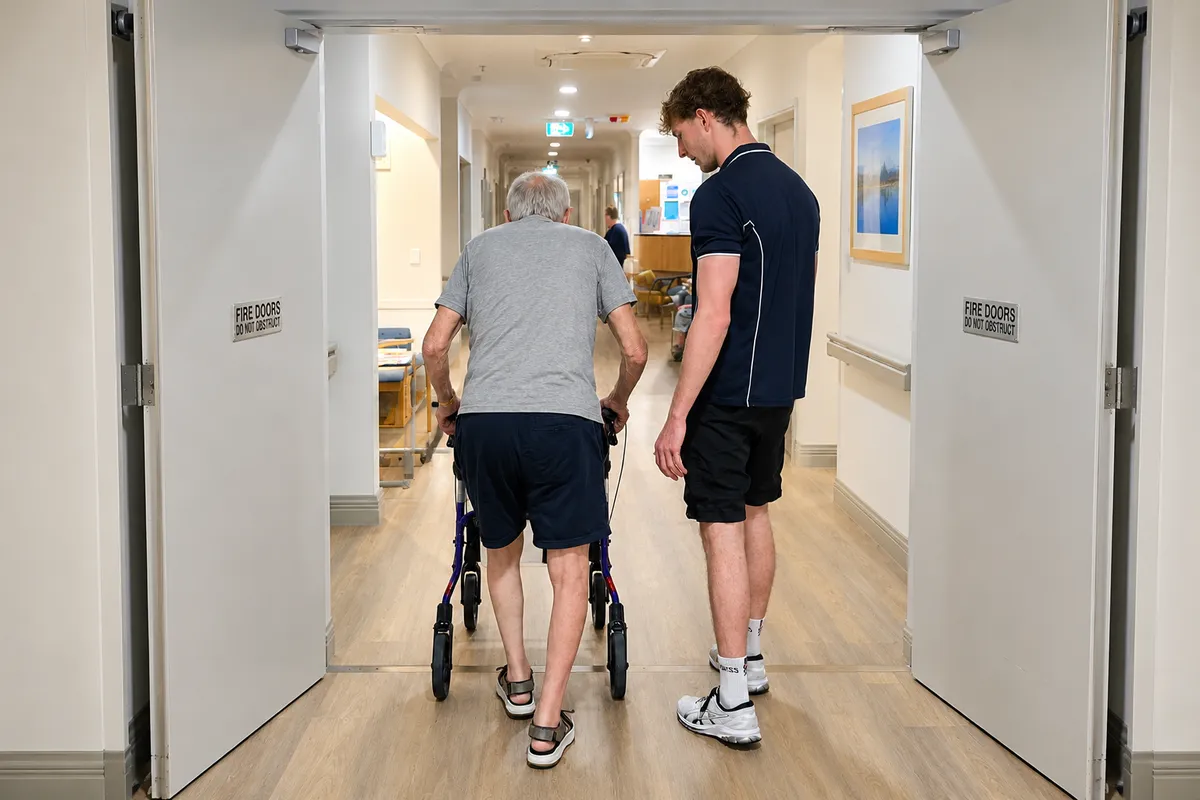
If you or your parent has a Home Care Package (HCP), the rules changed underneath you in November 2025. Most families we visit still call it a package, but the funding works differently now. Here is the plain-English version, including the part that matters most for physiotherapy.
Funding figures below are the published Support at Home classification amounts from health.gov.au, current as of 1 July 2026. They are indexed each July. Confirm your own situation with My Aged Care or your care provider.
What actually changed
Support at Home (SaH) replaced Home Care Packages and the Short-Term Restorative Care Program from 1 November 2025. If you already had a package, your funding carried across and you did not need to reapply.
The Commonwealth Home Support Program (CHSP) is a different program and has not moved yet. That transition is not expected before July 2027, so if you are on CHSP, nothing here has changed for you.
What you actually pay
Support at Home sorts services into categories, and your co-contribution amount will depend on the service category:
- No contribution for clinical support, which includes nursing, physiotherapy and other allied health services
- Moderate contributions for independence services, such as personal care and assistive technology
- The highest contributions for everyday living services, such as domestic assistance and gardening
If you have private health insurance, you already know how this feels. Your fund pays part of the bill and you pay the gap. Support at Home works the same way, except the gap, or co-contribution, will depend on which service category you are using. For physiotherapy there is no gap at all.
The cost still comes out of your quarterly budget. Your share of it is what changes.
From 1 October 2026, personal care also becomes fully funded and moves to no out-of-pocket cost.
What sets your contribution rate
Service category decides whether you contribute at all. Your personal finances determine your co-contribution amount.
Services Australia runs an income and assets assessment, much like the Age Pension means test:
- Full pensioners pay the lowest rates
- Part pensioners and Commonwealth Seniors Health Card holders pay according to their assessed income and assets
- Self-funded retirees without a Seniors Health Card pay the most
If you receive no government payments, do not assume you are in the top bracket. Submit your financial details to Services Australia and you may qualify for lower rates. If your income and assets are the same as a full pensioner’s, you pay the same rates a full pensioner pays.
If contributions cause you genuine financial difficulty, you can apply to Services Australia for hardship assistance. If approved, the government covers some or all of your contributions.
To estimate your own costs, use the Support at Home fee estimator on the My Aged Care website.
If you already had a Home Care Package
A specific protection applies to people who already held a package.
Anyone receiving or approved for a Home Care Package on or before 12 September 2024, the date the reforms were announced, falls under the no worse off principle. In practice:
- If you were not paying an income-tested care fee under your package, you will never be asked to pay contributions under Support at Home
- If you were paying one, you will only ever pay the same or less
What your funding level covers
There are eight funding classifications, and your aged care assessment decides which one you receive. The amounts below are current as at 1 July 2026, are indexed each July, and include the 10% set aside for care management.
| Level | Quarterly | Annual |
|---|---|---|
| 1 | $2,752.50 | $11,010.01 |
| 2 | $4,112.84 | $16,451.35 |
| 3 | $5,634.20 | $22,536.81 |
| 4 | $7,617.13 | $30,468.51 |
| 5 | $10,182.38 | $40,729.53 |
| 6 | $12,341.32 | $49,365.27 |
| 7 | $14,915.00 | $59,660.00 |
| 8 | $20,034.28 | $80,137.12 |
Two important changes from the previous system:
- Funding is released quarterly, not as one annual lump sum
- Unspent funds roll over, capped at $1,000 or 10% of the quarter, whichever is greater. Anything above that does not carry forward, so there is no advantage in holding funds back
Moving across from a Home Care Package does not change your funding level.
The Restorative Care Pathway
If function has dropped off recently, this is the one to ask about, and most families have never heard of it.
The Restorative Care Pathway is short-term, goal-focused funding for older adults whose decline may be reversible. The department lists it as a separate funding source from your ongoing classification, so it does not draw down your regular quarterly budget.
How it works:
| Feature | Detail |
|---|---|
| Duration | Up to 16 weeks per episode |
| Funding | Around $6,000 per episode |
| Uplift | Up to $12,000 where clinically justified, via a Support Plan Review |
| Frequency | Maximum two non-consecutive episodes in 12 months |
| Gap between | At least 90 days |
| Out of pocket | Nothing for clinical services |
It covers physiotherapy, occupational therapy, exercise physiology, nursing, and short-term personal or domestic help tied to your recovery goals.
This is built for exactly the situations physiotherapy handles well: getting back on your feet after a hospital stay, rebuilding strength after an illness, or recovering safe mobility and improving confidence after a fall. Because it is capped and goal-based, it suits a focused push rather than ongoing maintenance.
If there has been a recent setback, ask your assessor or care manager whether the Restorative Care Pathway applies to you.
How to add physiotherapy to your care plan
It is simpler than most families expect:
- Tell your care manager you would like physiotherapy included
- They add it to your care plan
- We invoice your provider directly, so there are no out-of-pocket fees payable by you
You do not need a GP referral for physiotherapy under Support at Home. We work with home care providers across the Gold Coast and are happy to speak with your care manager directly if that makes it easier. You can read more about our aged care physiotherapy service, or care managers can make a referral online.
If you are not sure whether physiotherapy is already in your plan, give us a call on 0490 427 392 and we will help you work it out. There is no cost and no obligation, and if we are not the right fit we will say so.

About the author
Jesse Whittaker
AHPRA-registered physiotherapist, APA member
Jesse is the founder of Shine Alliance and an AHPRA-registered physiotherapist who graduated from Griffith University in 2020. He works across the Gold Coast delivering physiotherapy in clients’ homes, with a special interest in neurological conditions, chronic and lower back pain, and balance and mobility.
More about JesseGeneral information only. This article is general education, not individual medical advice. For guidance specific to your situation, please speak with our team or your doctor.